Showing posts with label writing. Show all posts

Thursday, September 18, 2014

Nominated


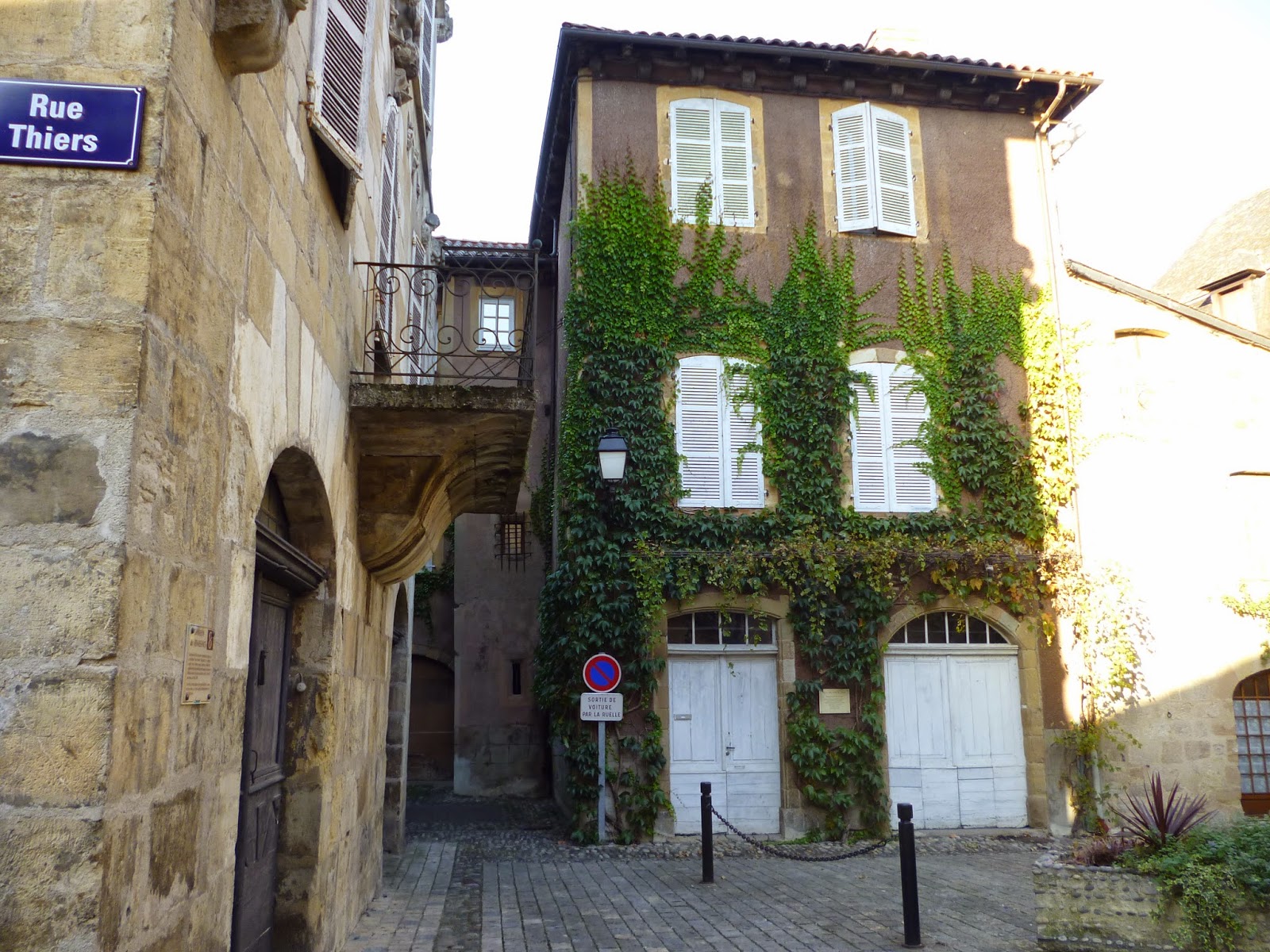
This is the house in Beaulieu sur Dordogne where seventy Jewish refugee girls were saved from deportation and almost certain death during the years of World War Two when Marshall Petain ruled France from Vichy. To the right and out of view is the massive Abbey of Saint Peter where church bells rang every quarter hour. Everyone knew who was taking refuge in that house, the priests, the parishoners walking to Mass. Beaulieu kept the house's secret. I weave the story of that house with my own house during those years, a yellow stucco house in Morristown, New Jersey in an essay, I call-- what else--"Houses."

And now, Scott Olsen, editor of ASCENT magazine has nominated that essay for Best Of The Net. http://www.readthebestwriting.com/houses-sandell-morse/

I am deeply honored and humbled.

Friday, August 22, 2014

An August Evening

Three orange plastic chairs. One that will be pulled off to one side for the moderator. The spotlight will be on two women, sitting in the center of a boxy wooden platform. Two low mikes on long arms stand ready for their voices. I sit in an aisle seat in the second row, sipping wine from a small Ball canning jar. This room reminds me of a warehouse, high plaster walls, no windows—the Space Gallery, Portland, Maine. I’ve come to listen to Roxana Robinson and Ann Beattie read from the work of writers they admire, then discuss their selections. Later, each will read a selection from the other’s work. They rise from front row seats in the section on my right, Roxana leading. She wears red ankle length trousers, a white and black striped three quarter sleeve top, a black and white striped matching cardigan tied over her shoulders, red flat canvas shoes with closed toes. Ann wears black and white. What I notice about Ann are her long fingernails, polished fire engine red, then her toenails, polished the same red. Each has chosen red for her splash of color.

The selections they read are by Peter Talylor, Robert Stone, Grace Paley—Ann; Elena Ferrante, Hillary Mantel, Alice Munroe—Roxana. Now, Roxana reading from Ann Beattie’s “In the White Night,” then, Ann reading from Roxana’s Sparta. All of the writing is arresting. Stunning. Some writers rely on exposition, others on scene—which ever each chooses, he or she is a master. Each voice is unique.


How delightful to listen to two very smart accomplished writers talking about writing. But I as a writer can’t aspire to write like any of them—and I shouldn’t. Each’s wonder, each’s brilliance springs from an unknown quality that is his or hers alone. As I leave the gallery and step out into the cool of an August night, their words, their stories, their characters, the moods they create linger like a brush of silk on my skin. 

Tuesday, August 5, 2014

That Night

Sam and I in better days. 
I’ve been meaning to blog all of July, hoping to get a post up before the month ran out; then, life rolled in like a tsunami, sweeping away intention. The only thing left was that night, Saturday, July twenty-sixth. Two dogs, maybe four, attacked Sam, my beloved standard poodle. Dick, my husband and I, had left Sam in the care of a dog sitter, a woman we knew. What we did not know was that she would leave Sam and her four dogs gated in her living room and leave on her bicycle to get ice cream. Her housemate found Sam lying in front of the gate, his breathing harsh and gurgled, his fur soaked with blood. Sam survived, still survives with severe bite wounds to his neck, impaired breathing which may require surgery to open his air ways, nerve injury to his right eye. He can’t blink. May never blink.

That Saturday night, the veterinarian gave Sam a fifty-fifty chance. It was two in the morning when Dick and I arrived at the hospital. Sam lay on his side, in an oxygen cubicle, his neck so swollen, he looked like he was wearing a ruffled Elizabethan collar. He smelled foul—like blood and rotten flesh. His fur has been shaved, revealing severe bite wounds to his neck, one about four inches long and two inches wide—and so deep. His white skin was the color of strawberries. An IV dripped into his left front paw, administering fluids, morphine and antibiotics. I held my hand to his nose. Sam licked my fingers.

For days my sadness was visceral, sapping my energy and my strength. I couldn’t read. Couldn’t write. Couldn’t think. I could empty the dishwasher, walk in the rain. This was grief. For Sam’s suffering. For his wounds. I blamed myself. I shouldn’t have left him with a woman who owned four dogs. Shouldn’t have made Sam the outsider. Wasn’t that what I wrote about, the outsider? But the woman knew Sam. Sam knew her. And he’d spent time with her dogs. But never without the woman present. She was distraught. So sorry. She would pay. She didn’t care how much. She wanted Sam to live. She didn’t know what she’d do if Sam died. Early, in his care, I set limits. No resuscitation. No breathing tubes. If Sam was going to survive, he’d need to pull through on his own. Sam has a big heart, a steady slow determination.

After five days, I brought him home, that large wound still open and draining, smaller wounds open and draining, too. I changed his dressing, fed him pills, antibiotics, painkillers, an appetite stimulant, each wrapped in brie. Brie is soft and smelly. Sam loves smelly. I sat on the floor applying warm compresses to his wounds. Sam leaned back into my hand, the hand that used to bandage a son’s skinned, then lift a lock of sweaty hair from a forehead. With touch, Sam’s breathing eased.


This morning, Sam lies on his bed in my study. This is our routine; Sam rests in my study as I write. And I’m beginning to write, first this blog, then perhaps, tomorrow, I’ll return to the work I left before the night of Sam’s attack, my book of essays about Jews, war and Vichy France. Sam has patches of dead skin that may transform into open wounds. Weeks will tell the extent of injury to his trachea. It will be months before we know if those nerves in his face will regenerate. I stoop down to scratch, lightly, on his head. He doesn’t move. He is content, hardly laboring as he breathes. Perhaps, no surgery. I turn back to my desk. Together and slowly, Sam and I re-enter our lives.

Sunday, June 22, 2014

Balance

My residency at the Virginia Center for the Creative Arts ended a month ago. While I was there, a friend and fellow writer sent me an email. She was working on a lecture/essay about the challenges of maintaining balance in our lives as artists. At that moment, I put the email aside. Nothing was farther from my mind. I was the person I was meant to be, rising early without an alarm, doing yoga in my pajamas, dressing, then walking slowly out to the barn and my studio, carrying a half a grapefruit, a boiled egg, both of which I’d picked up in the dining room, entering and leaving, wordlessly. I’d walk past a paddock where horses ambled, their breath coming in ruffled snorts. At my studio, I’d insert my key into the lock, then enter the stillness I’d left the evening before. In a nearby kitchen, I’d plug in the electric kettle, and as water heated, I’d look out a window and watch bluebirds. After brewing my first strong cup of my day, I’d sit alone at an outside table or in my studio where I’d already pulled a big old broken down overstuffed chair to a window. There, I’d eat my egg, perhaps some fruit, maybe crackers with peanut butter or cheese. Surrounded by silence, I’d watch the sky, and all this time I would not have spoken a single word, so that when finally I’d take up my pen or go to my computer, the subconscious writing, my brain had done the night before was waiting and ready to pour forth.

Nights, after dinner when I’d walk down the long front drive, I’d seen a sign: “Entering the Real World.” The VCCA is an alternate world. A different world. Now, I wonder, is what feels like balance to me it’s opposite? Since I first learned about them in high school, I’ve been drawn to utopian communities, Brook Farm, the Transcendental community outside of Boston, the Shakers. I was the kid who loved camp. Now, I love the VCCA or retreats of my own making when I travel abroad, rent a room, research and write. When I write, I enter what my friend and fellow writer, Alexander Chee calls a fugue state. Alex says, “… when you enter the fugue state required for making art, you can’t really be a normal person. The good news is that at a colony, you’re not expected to—you’re expected to be civil to other colonists and respectful, but not normal. It’s a huge relief.” And I might add that travelling solo, knowing no one affords that same freedom and relief.


So here I am one month later, back in the real world, and I’m juggling, tossing balls up into the air: doctor and dentist appointments, commitments to family, to friends, to Sam, my standard poodle. I’m doing yoga, hiking into the mountains, walking, daily, swimming, gardening, travelling—and I’m reading and writing. My life is rich and full. Yet, I yearn for the VCCA where I live in a fugue state twenty-four seven. At home I enter that state for short periods. That, I suppose is real life. As for balance—which I perceive as equilibrium—that’s not me. I juggle; I totter. And I dream.

Monday, June 9, 2014

A New Week

     Taking stock of my week on Monday after the new week has already begun, but that's the way this past week has been for me. I'm running behind the bus, arms outstretched, yelling, “Wait for me.” Not the best feeling. So far today, I have managed 45 minutes at my computer working on an essay, an hour yoga class, breakfast, my second cup of coffee with Sam, my standard poodle, behind me on his bed chewing a treat I've given him. His sounds calm me, and so I'm trying to breathe, to say, this is my life. At this moment I write for as long each morning as I can before life intrudes in the way of  my yearly physical which I put off until it catches up with me, the dermatologist, the dentist, the birthday gifts and cards, the graduation gifts and cards, events that I scheduled long before my calendar got full. You know how it goes. So this last week my major writing accomplishment was finding a title for the essay I'm working on about Germaine Poliakov, a ninety-five year old French woman who was a caretaker in a house hiding Jewish refugee children during the Second World War. I’m calling the essay "Connecting Threads." I like the way the title moves backward and forward. I've been tearing the essay apart and putting it together in a new way. I got about four new pages this week. I've also been searching for material for a workshop I'm teaching at the Ocean Park Writers’ Conference in Ocean Park, Maine in August, but I need my course description in about a week. West Moss, friend and writer, helped me move my thinking away a narrow technical focus to something more open and much more fun. Thank you, West, for your help. I think I've found a perfect essay for the group to read and talk about, "Traveling," by Grace Paley. It's in her book Just As I Thought. If you haven’t read the essay, do. She did, then, that we’re talking about with essays now, a lyric, braided essay—of course. What else?


Sunday, May 12, 2013

Mother's Day


           I am in Paris alone, and I cannot think of a better way to spend this day, than letting it unfold. I passed part of the morning at my computer, transcribing notes, adding impressions Then, I walked to the Place Bastille to search for the entrance to the Promenade Plantee, an elevated walk built on the abandoned tracks of Bastille Railway Line. Here the walk is narrow, the gardens lush. People stroll; joggers jog; a few children ride bicycles, although bicycles are forbidden. They day is breezy and cool, partly sunny. Midway along the walk, I descend, find a patisserie, buy a small quiche, a bottle of water, then reenter the walk, passing the Jardin de Reuilly. Here, the walk turns surprisingly urban. Walking and searching for seclusion, I find a bench, eat and watch passersby, my thoughts drifting.
As the walk again becomes urban, gardens are strewn with winter’s debris. No one has raked fall leaves. Many of the city’s gardens remind me of Manhattan in the seventies when the city’s parks had been neglected. Money? Probably.
I’ve walked for more than three kilometers, one more until the end. But I lose my way. I’m on city streets. Making my way back to the Promenade, I descend at Gare de Lyon. In a bar, I order a double espresso and wonder what I’ll do next, go back to my hotel? Find the Musee de Nissim de Camondo? My phone rings. My son is calling to wish me a happy Mother’s Day, my husband to wish the mother of our sons a happy Mother’s Day. Their voices feel close. They feel close. Yet, I’m happy here at this far away table. This is the writer in  me, seeking not isolation, but the solitude of my own thoughts. I’ve come to Paris to go to the wedding of a friend’s son and to do research for a series of essays I’m writing about hidden Jewish children during World War Two. Today, though, I am absorbing the city.
            My metro stop is the Park Monceau, a beautiful eighteenth century park, filled with gardens, families, lovers. A carousel turns. There are statues, rock sculptures, small pools. Here, I’m happy to say, someone has raked. On the Avenue Monceau, I enter the Museum, built by Moise de Camondo, heir to a banking fortune, and mentioned in one of my favorite books, The Hare with Amber Eyes. In the book, Edmund de Waal, tells a the complex story of his family with simplicity (and I mean that in the best sense of the word) and grace. Waal’s family, the Ephrussis lived down the street from the Camondos, and like the Camondos, they were wealthy Jewish bankers. Inside the mansion, I walk with an audio guide, listening to stories of the family, of the house, its art, its porcelain, and as I listen I tried to imagine living in such wealth. Impossible.
Moise built the house for Nissim, his son, who, sadly, was killed in action during World War One. Moise’s daughter Beatrice wasn’t interested in the house or the art, so Moise donated the house to the Musee des arts decoratifs, upon his death, along with a foundation to fund it. He died in 1935.
Shortly, before the Nazi invasion in 1939, Beatrice converted to Catholicism. Thinking her French citizenship would protect her, she and her family stayed in Paris. An equestrian, Beatrice rode horses with German officers. In 1943, the family was arrested (Gestapo? French police?), sent to Drancy, a transit camp, then murdered in Auschwitz in 1944.  
            Meandering through the Parc Monceau, I sit on a bench, call my family in Colorado. It’s morning there, and my son has a made a frittata for breakfast. It’s ready, so we talk briefly. I speak with my grand daughters. It’s nearly six in Paris. Still, light, still breezy. I study a Metro map, then after three rides, I’m sitting on one of the large wide bodied boats that cruise the Seine. The motor is too loud, and it stinks. The commentary in four languages is overpowering. Still, I feel the comfort of motion, a slowing down, as if to settle the complexities of my day, the gardens, the carrousel, the children in the park, the sad legacy of the Camondos, their gift to the French state, their murder in Auschwitz.
            I’ve hardly eaten all day, and when I leave the boat, I realize I’m starving. Entering a restaurant on the Place d’Alma that I know will be overpriced, I allow myself to be seated at a table. I’m here because I like the décor, so French, scarlet banquettes, fringed lampshades, tinted mirrors, crisp white linens, attentive waiters. I’m here because I’m exhausted. My salmon is fresh, decent. Uneventful. Still, I’m content, sipping wine, watching traffic and pedestrians, the Eiffel Tower rising in the distance, my thoughts like wheels, turning and turning. 


Tuesday, December 18, 2012

Sentience


Awareness. Is awareness one of the ten values I will name preparing for my Bat Mitzvah? The word feels strange on my tongue. Aware meaning cognizant, conscious, alert. Ness, a suffix attached to an adjective or a participle to form an abstract noun that denotes a quality or a state. Such as: goodness, kindness, darkness. A synonym of awareness is mindful; an antonym, oblivious.
Last Friday, before the snow that fell over the weekend, I drove home, pulled into the garage, and as I stepped into the kitchen, Dick said, “How do you like your fields?”
He’s like that. No hello. A quick question. After all these years, I still can’t take a breath. I blurt. “What fields?”
“Out by the driveway. Didn’t you notice them?”
I’d asked to have those fields cut down at the end of summer, but neither Paul nor Matt, the two men who run the lawn crew had managed to get the job done. Then, Matt had a stroke, and the fields became unimportant. I figured someone on the crew would cut them down in the spring. But Paul arrived. Probably, he’d listened to the weather report. I hooked the dogs to their leashes and walked outside. Tall stalks of dried grass lay on the ground like pick up sticks, small birds foraging. 
To be aware. To notice. To take in. That’s my job as a writer. So why, when I’m not in my writing space—space being both a state of mind and a place—do I check out? Because awareness is hard. To be present, cognizant, conscious, alert. That is one edge of the knife blade for a writer. The other is a kind of drifting inside that space, what I call space around the space.
But back to my drive along the driveway. What had I been doing inside my car? Listening to a C D of George Eliot’s Middlemarch, a book I’ve wanted to reread for years, and knew I never would, so I borrowed the tapes from the library. My attention was focused on listening and on watching where I was going. Perhaps, awareness is inward as well as outward, a sifting of stimuli. And what of complete inattention, a moment last summer, sitting on a weathered wooden bench at the edge of the sea, dogs at my feet, the scent of salt, the squawk of gulls, my mind as open as the sky? Perhaps, that, too, is awareness.
Still that word, awareness, chafes. Is sentience my word? An online dictionary defines sentience: feeling or sensation as distinguished from perception or thought. No, that doesn’t work either. Perhaps what I value is sentient awareness, a place where unknowing and knowing intertwine. 

Saturday, December 1, 2012

Let's Talk


What makes a value Jewish? How can Judaism claim what many of us value, Jewish or not? I shift in my chair. Face Lev. This is another moment in that Starbuck’s in Winchester when we met. In front of me, a display of red and white mugs, wrapped with red bows. Outside, the white lights of Christmas. Lev gives me a knowing smile. “So, Judaism gives us this, these values and it (Judaism) includes anybody who has these values.”
So because I am Jewish, exploring values such as my love of learning or my commitment caring for others, those less fortunate or those who are sick, in a Jewish context, those values become Jewish. Is that what Lev is saying?
“Yes,” he says.
And here I am—it seems—exploring a constant theme in my life and my work: Jewish identity. When I began my writing life as a fiction writer, none of my characters was Jewish, and many of my stories lacked an authenticity, something intangible that shone through certain characters. I, the writer, was wishy-washy, refusing to declare an essence. Was that character Jewish? I, the character and the reader needed to know. But in real life, I could pass, and I did, sometimes declaring I was Jewish, sometimes not. I hid behind a wreath on my door, a Christmas tree in my living room. The only Jews in our rural New Hampshire town where I was raising my family, I truly believed I could live inside the landscape of a Currier and Ives print. Walking into woods behind our house with my husband and my sons, we would choose a tree, chop it down, drag it home through snow.
Those romantic images of country life have an underside. When I began teaching language arts to fifth through eighth graders in my town, the two most hurled insults on the playground were the N word and Jew. I denounced both, told my class I was Jewish. A sixth grade boy brought me a book: The Protocols of the Elders of Zion. Published in 1902, The Protocols is a anti-Semitic rant, purporting to describe a Jewish plan for global domination. It is a forgery. That same sixth grader asked to see my horns. I’d thought such myths associating Jews with the devil had died out with the middle ages, but he year was 1972. I taught tolerance. At home, I told myself, I could do both, turn on the lights of my Christmas tree and light my Hanukkah menorah. My children were wiser. “Mom, it’s too confusing,” Richard my oldest son said. “Can’t we just celebrate Hanukkah.”
            And we did.
            As the years passed, I became more and more visibly Jewish which meant for me, studying Torah, especially the women of the Hebrew Bible. I read and I read, diving down into the wealth of Jewish learning. I brought what was deep inside of me to the surface, memories of cooking with my grandmother as she prepared shabbos dinner, then circled her thick fingers over the candle flames before blessing the shabbos candles. I learned the prayer, moved my own fingers in a circle, and gathering in goodness and light, I blessed the candles inside my grandmother’s brass candlesticks.
So, is Jewish identity a value I can pass on? Although I’d like to do just that, I can’t. Each of us has our own journey toward that philosophic search for self. What I can pass on is a desire to know and to learn. A wealth of Jewish learning trails behind us. Only by knowing where we came from will we learn who we are. 


Judaism is a religion of dialogue. I invite your comments. Let’s talk. 

Wednesday, April 25, 2012

Papa's Yhartzeit


Looking for oncoming traffic before turning on to York Street on my way to a yoga class, I saw the lead hearse in what turned out to be a very long funeral procession. Tears welled, and I cried. I had no idea who had died, no idea where those tears had come from—until at lunch, I told the story to Dick, my husband. “Is it anybody’s yhartzeit, (anniversary of a death)?” he said. “In April?”

I shook my head. “I don’t think so.” 

Then, memory flooded back. I ran upstairs, opened the drawer of my bedside table, found the small piece of paper where I’d written my grandparents’ birth dates and the dates of their deaths. Abraham Block, April 25, 1958.

I raced downstairs. “Dick, what’s the date?”

 “April 25th.

“You’re sure?"

He gave me one his looks. 

"It’s my grandfather’s yhartzeit. I can’t believe it. How can that be?”

"I guess you remembered."

Taking a yhartzeit candle from a cabinet, I struck a match. No, not I. I didn't remember. Perhaps, my body did. But I wouldn't have known, really known unless I'd told the story. 

Thursday, March 15, 2012

The Agent Search


I’m a writer searching for an outlet for my memoir, querying agents, gathering information on independent presses, thinking of going indie—indie, the cool way to say self-publish. I want an audience for my book, and that’s why I’ve driven nearly seventy miles to hear Jason Allen Ashlock’s talk, Agents For Today’s Author, a talk sponsored by Grub Street of Boston.

Jason stands at a podium inside a YMCA on Massachusetts Avenue in Cambridge, Massachusetts. It’s a warm March evening. I shed my sweater, pull my blouse from my skin. Jason is young, probably in his early thirties, looking younger, vibrant and energetic. Intelligence and understanding pool in his deep brown eyes. He greets us, warmly, then asks: “Is the traditional literary agent still viable?” A brief pause before he answers. “No. Or not for very long.”

All of us in this audience know publishing is in crisis, smaller catalogues, fewer bookstores, fewer books sold. The industry is top heavy, investing somewhere in the range of $300,000 to bring a book to market. What if the book doesn’t sell? Returns flow back to the warehouse. No wonder agents tell me they’re only selling celebrity memoir or memoir with a strong enough hook which generally translates to drug addiction, alcohol addiction or dead babies. Why? Because they’re pre-sold.

And that’s where the digital revolution comes in. “Digital,” Jason says, “shifts the value chain to a value web.” The agent used to be the way a writer reached her reader. The chain was linear, writer, agent, publisher, distributor, book store, reader. Now, a writer can reach her reader in multiple ways, and because of this, agents are squeezed. Some have left the business. Some are charging fees. Some are serving as their clients agent and publisher. Others, like Jason, are changing the look of the traditional agency, becoming involved with design and marketing, moving from the background into an open explosive force. Jason says, “An agent’s job is to manage the possible in the digital space.”

And in this shifting digital world, Jason tells this audience of writers that we will need to become our own agents for a while. This is a spin on the advice we’ve been give for a while now with a difference. Jason is suggesting that agents get involved in helping writers launch their books in a new way. Is that way really new? Take my memoir. I’ve published excerpts, one winning a prestigious prize, in my quest for audience and a platform. Jason is suggesting that before an agent takes a book to a publisher, that agent might find digital ways to launch a writer’s work, perhaps by asking that writer for an eBook or perhaps an excerpt on various sites to create a buzz. Not so different from my traditional publishing in the literaries. But—in order for Jason to take on a client who writes a literary memoir, such as mine, he said when we spoke briefly after his talk, he needs to believe there’s a large audience out there for that book. The old catch 22? Not quite. I believe there’s more flexibility in this new model. So, Jason, expect my query. 

Sunday, February 5, 2012

Memoir, Straight Up

Last night after watching the film, “The Artist,” the beautiful many layered story of a silent film star tossed aside when talkies come in, I slept badly, dreaming of closed doors, a filthy outhouse. I awoke disgusted, climbed out of bed, walked downstairs in the dark and made myself a cup of coffee.

I’m a writer of a certain age, trying to bring a literary memoir to publication which in today’s publishing climate seems to have as much relevance as a silent film. Five years ago, my credits in literary magazines, Ploughshares, the New England Review, the fact that chapters from this book have been published, one winning a prestigious award, would have made an agent notice. Now, few agents answer my queries, and those few who do, send a polite, but form rejection.

The culture has gone visual, and ironically as movie and television screens have grown larger, the book has grown smaller becoming an image on a laptop, an iPad, an iPod. Is the book dead? I don’t think so, but I do think traditional publishing is not only in transition, but as Steve Almond said in a recent seminar I attended, “crumbling under the weight of its own inefficiency, and what’s suffering is anything literary.”

In my query letter to agents, here's the way I describe my book: Girl Wrapped In A Curtain is a scene driven 78,387 word literary memoir that explores the complexity of love between a father and daughter. That day, sitting at the table with eleven other writers, all of us trying to figure out how to publish our books, traditional, electronic, small press, do it yourself, I nearly laughed out loud. Literary, once a respected word, was now the kiss of death.

I don’t even want a big New York publishing house. I’d like a small press, but I still need an agent and agents keep their eyes on the big houses, going to smaller presses later. Agents and editors say what’s selling are celebrity memoirs and memoirs with a hook, which means sensational, ie abuse, addiction or mental illness. My book is my story of coming to love my difficult, mean, charming, manipulative, narcissistic father. He is my Rochester; I am his Jane, for Dad is ninety-one, half-paralyzed, bedridden, incontinent and demented with startling moments of clarity and dying when, finally, he lets me into his life. Is he conning me? He’s that kind of guy.

So, who’s my audience? All of us out there who will be, who are, who have cared for aging parents.

Back to “The Artist.” Leaving the movie theater with me, my husband said, incredulously, “That was a silent film.”

Yes, it was. A modern silent with the old embedded in the new. My book is memoir, straight up. I’m not claiming the artistry of “The Artist;” yet, like the silent film star in the movie, who needed to find his way back into film, I need to find my way into publishing my literary memoir. 

Friday, November 19, 2010

So Just What is a Writers' Colony?

For years now I have made my pilgrimage to the Virginia Center for the Creative Arts, the VCCA, an artists’ colony at the edge of the Blue Ridge Mountains in rural Virginia. Before I leave, friends wish me well. “Happy Writing,” they say; or, “So you’re off to writers’ camp;” maybe, “Have fun at your workshop;” and the most bold, the most direct, “I don’t understand why you have to go there.”

So just what is a writers’ colony?

The VCCA sits on a hill top surround by fields where cows graze. Out the back gate are country roads, narrow and unlined where the few cars that pass drive fast. There are small houses, where if you turn right, you’ll find mostly African-Americans; turn left and you’ll find white folks. Dogs roam freely. The are woods. On my walk, today I passed a field where, under the bright Virginia sky, goats grazed. Sun shone down. There was a breeze, and birds thought fall had turned to spring. I passed no stores, no strip malls, no baseball fields or tennis courts.

Back on the grounds of the VCCA, I sit in my studio, the corn crib, a free standing building that looks like Hansel’s and Gretel’s cottage, and yes, it was a corn crib with its slanting walls and slanting roof. I sit at desk, my computer in front of me. There is a bookcase, an upholstered chair, a single bed, box spring and mattress on a metal frame. I don’t sleep in that bed. I sleep in a residence hall about a football field or so, down a driveway and across a wide lawn. The bed in the studio is for what Virginia Woolf called her well. When it went dry, she waited until it filled again. So I lie on my studio bed, my well fillling my mind drifting, aimlessly, it seems, but not airmlessly, for my sub-conscious brain is hard at work. Here, the phone does not ring. I don’t collect mail, and the real world is far away.

Around me in studios I cannot see other artists work as I do, writers, painters and composers, all of us toiling long hours in our solitary spaces, coming together for meals, although some choose to eat alone, sharing our work at readings and open studios, although, some choose not to share. They’re not shy. They’re simply not ready.

Because we are here, together, something happens. It is as if invisible seeds fill the air. We feel them them floating, and we plunge deeper into a story or a painting. Perhaps, we try something new, return for dinner estatic: a break through. If this sounds a little woo-woo or new age, think of yourself when you were a child, the way you built whole cities out of sticks or sat mesmerized by a rainbow inside a puddle after rain. This is the artists’ world, cities out of sticks, a rainbow in a puddle. Here, we have the space around the time to squat down, to look, to listen, to fill the well. Here is where art is born, then suckled. We are kindred spirits, kindred souls.

So yes, this place is all of the things you asked about, writers’ camp, workshop, and now you know why I'm here.